
The city is known internationally for being home to one of the seven "New" Wonders of the World, the Iguaçu Falls, and our guide André is going to tell us a little bit about one of the most sought after Brazilian destinations.
The city can be visited all year round. The months of January and July are considered to be high season, in addition to the end of the year’s holiday season and long weekends throughout the Brazilian public holiday calendar – these are all times when Foz usually welcomes thousands of travelers at a time. The summers here are extremely hot, humid and with temperatures over 40°C during the day. Winter is cool but still humid, with temperatures close to and even below 0 °C at night and with highs of about 20 °C throughout the day. This said, Foz can be visited throughout the year, but we’d recommend traveling in the shoulder seasons of spring and fall.
1) Iguaçu Falls. Considered by UNESCO as one of the 7 New Wonders of the World in 2011, the falls are, without a doubt, a magnificent spectacle. Located on the Iguaçu River, on the border between Brazil and Argentina, the falls extend for 2,700 meters, the highest of which is known as the Devil’s Throat at 80 meters. We recommend visiting both the Brazilian or Argentinean side, since you get a unique perspective from each.
2) Itaipu Binacional. Another important symbol of our city. Considered one of the Wonders of the Modern World, Itaipu is the largest hydroelectric plant in the world. It is responsible for supplying 80% of all energy needed in Paraguay and 17% in Brazil. A work of gigantic proportions, with a dam almost 8 km long and 196 meters high. There are 20 generating units capable of producing 14 thousand/MW and a spillway that is capable of draining up to 42 thousand m2 of water per second. During the tour, aboard panoramic buses, the guides guide tourists through some of the most important areas, telling the story of the complex’s construction, and how it changed our entire region.
3) Paraguay. The city of Foz do Iguaçu is set in a triple border region. Just cross a bridge to reach Paraguay, one of our neighbors. The Paraguayan border town is called Ciudad Del Este. It is the second largest city in the country with a population of nearly 400 thousand. Ciudad Del Este is known for its multitude of stores and malls with imported products of all types and world-famous brands. There are perfumes, beverages, electronics and much more. Very close to the shopping area, still in Paraguay, there is another attraction on the border – The Saltos Monday. Called the ‘Paraguay Falls’, the falls are 40 meters high in a semicircle shape, with an average flow of 100m3. They are located in a Natural Reserve area of approximately 460 hectares and the park offers complete infrastructure for visitors. Other attractions in the nearby Paraguayan city are Casinos and upscale restaurants with great options for dinner.
4) Argentina. On the other side of Foz do Iguaçu we have share a border with Puerto Iguazu, in Argentina. But unlike the Paraguayan city, Puerto Iguazu is a small, quiet town in northeastern Argentina with just 85,000 inhabitants. The city, however, receives thousands of tourists every year to visit the Iguassu Falls from the Argentine side. Like the Brazilian park, the Argentine side has excellent infrastructure with trails, walkways and viewpoints to observe the falls. At night, Puerto Iguazu also attracts tourists to its Casinos and restaurants, famous for their excellent Argentinean meat.
5) Macuco Safari + Parque das Aves. Both are located in the Iguaçu National Park area. Together with the Falls, they form a “”trio”” of most visited attractions in Foz do Iguaçu. Parque das Aves faces the Cataratas Visitors Center. It occupies an area of 16 hectares of native forest right next to the National Park. It opened in 1993 and is currently the largest bird park in Latin America. There are more than 1,300 birds of 130 different species. Its focus is on the preservation and reproduction of Atlantic Forest birds. Here, you will find huge aviaries where tourists can enter and see some of the most beautiful and rare birds in Brazil. The nurseries are designed so as not to
cut any native trees and entirely immersed in the forest. Macuco Safari, on the other hand, is the most fantastic tour you can take in the Falls. They are twin-engine boats that take tourists through the rapids upriver until they reach the falls. The tour starts in the inner area of the National Park, just before the trails and viewpoints. There are three parts, the first of which is a tour on small trucks pulled by electric cars where guides explain more about the local fauna and flora. The second part consists of a walk along a suspended trail to better appreciate the greenery of the National Park. The final part is the boat ride that goes up the river, passing by the rapids to the Falls. After a brief stop for photos, the boat approaches the falls so that visitors are doused by the massive waters.
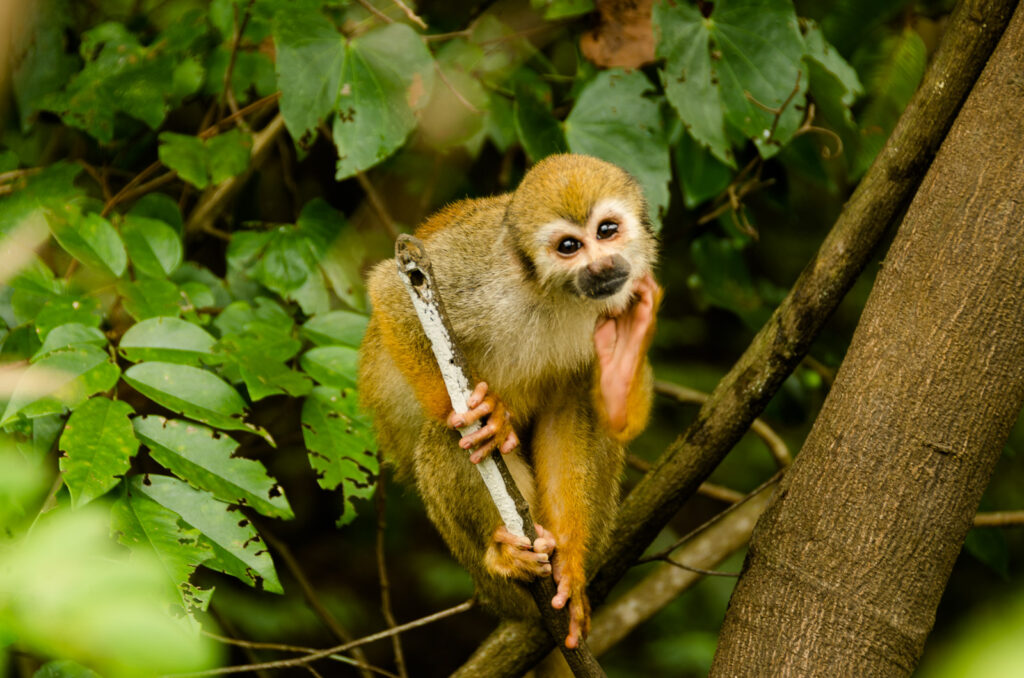
The type of forest found in the National Park at Iguaçu is called Interior Atlantic Forest (semi-deciduous). It means that part of the trees lose their leaves in winter, the seasons are more defined than in other parts of the Atlantic Rainforest. The trees here do not grow as much either, with the tallest reaching 35 meters. Most common here are the peroba-rosa, cedar and araucaria trees, the latter being a symbol of the state of Paraná. Overall there are more than 700 species of plants. The animals total more than 150 species of mammals, 390 of birds, 48 reptiles, that we know of! The largest mammal living in the park is the Tapir, which can reach up to 300 kg.
There are also 3 large feline species – the ocelot, puma (sussuarana) and the jaguar, the largest carnivore in South America and the third largest feline in the world. On the trails and walkways of the Falls, it is common to see capuchin monkeys and toucans, in addition to the famous and friendly coatis. Related to raccoons, the coatis roam in packs. Its coat has shades of grayish-yellow, a long snout and tails that can reach 55 centimeters. They are always present near snack bars and restaurants in search of something to eat, not to mention the times they end up attacking visitors’ backpacks to steal food (you have been warned!). The coatis are almost an attraction in themselves when visiting the Falls.
The borders with Paraguay and Argentina make everyday life in Foz do Iguaçu a unique cultural mix. There are more than 700,000 people moving almost freely between the three countries, each with their own customs and traditions. The Paraguayans tend to preserve much of the culture of the Guarani People. To take a city tour through Paraguay is to walk through Indigenous customs, having, for example, a cuisine rich in foods made from corn such as ‘chipa’ or ‘Paraguayan soup,’ or you will see many people carrying around the most consumed drink in the country – Tereré. This is a kind of herbal infusion with ice water. Paraguayan handicrafts usually use a lot of lace and wood, and make for great stories and souvenirs.
Argentineans, in turn, have customs strongly acquired from its European colonization. This is reflected in the cuisine, with dishes based on red meat, pasta, potatoes and bread – almost always accompanied by a delicious Argentine wine from Mendoza. Dinner in Puerto Iguazú is always a great bet! And on the Brazilian side, Foz do Iguaçu is a city which grew with the construction of the Itaipu Power Plant and for this reason, there was a large migration of people from all regions of the country and even the world. There are currently more than 80 different nationalities living in the city. The most expressive of these ethnic groups are the Arabic population. In the city, we have the second largest population of Muslims in Brazil, mostly of Lebanese, Syrian and Palestinian descent. Arab cuisine is part of the daily lives of residents on the border. The Mosque is open to visitation, being much sought after by travelers. Foz do Iguaçu also has a large population fo Asian descent, especially those whose families have come from Japan, Korea and China. Some of these descendants have introduced the Buddhist tradition to the city, and the Chien Tien Temple has become an attraction fo its own. Located in the North area of Foz, near the Itaipu plant, it is open to visitors. In the temple’s huge garden, visitors find more than 120 statues of different representations of Buddha, and here you will also find one of the prettiest views of the city.
All this mixture of cultures and countries is very well represented in the Marco das Tres Fronteiras. It is the place where the two great rivers of our region, Iguaçu and Paraná, meet, while separating the three countries – Brazil, Paraguay and Argentina. From Brazil, Paraguay can be seen on one side and Argentina on the other. Here, each country built an obelisk and painted it in their national colors to demarcate their territory. This is also where you can experience a stunning sunset. In addition to the obelisk and the rivers, now visitors come across a kind of theme park on site, with buildings which recall the old Jesuit Missions of the 16th and 17th century, explaining how they modified and shaped
these territories known today as Brazil, Paraguay and Argentina. In the early evening, the attraction also offers visitors performances of typical dances, such as the polka and cantaro from Paraguay, the tango from Argentina and samba from Brazil.”
Foz do Iguaçu is a destination for all audiences. The city is one of the most sought after by Brazilians and is the second most visited destination by foreigners in Brazil. A complete destination that includes:
★ Exuberant nature of the National Park and the Falls;
★ Shopping in Ciudad Del Este;
★ Cultural attractions for the whole family such as the Muslim Mosque, Buddhist Temple and Itaipu Ecomuseum, amongst others;
★ Cultural shows at Marco das Três Fronteiras, Churrascaria Rafain and others;
★ Casinos in Paraguay and Argentina for those who want to try their luck;
★ Fantastic Hotels, Hostels, Inns and Resorts for all budgets;
★ Restaurants of all types and tastes for those who like diversity in the menu. Including menus signed by internationally recognized chefs. Paraguayan, Argentinean, Arabic, Italian, German, Chinese, Japanese food, in addition to our traditional and also diverse Brazilian fare.”

André Luiz is the perfect person to introduce you to Foz do Iguaçu, because he has already worked in several areas within travel, and in the city! He is a regional tour guide, accredited by the national tourism board, working effectively since 2011. He speaks fluent Spanish and English, and has a degree in Biological Sciences. Before starting to work as a tour guide, he worked at the company Macuco Ecoaventura, within the Iguaçu National Park, as a trail monitor on the Poço Preto Trail and Macuco Safari tour for three years. He then worked for the Parque Tecnológico de Itaipu Foundation, tourism sector at the Tourist Reception Center at the Itaipu Tourist Complex for 3 years. He worked as a sales consultant at Loumar Turismo’s call center until he left to work as a self-employed Tour Guide. Since 2015 he has been running the Iguassu CityTour as tour manager and guide.
Or if you prefer, email us at info@viare.com.br or call +55 (11) 3042-2515 or +55 (11) 96592-8845 (whatsapp)